Agricultural Solar Panels Kansas: A Complete Farm Guide
Why Kansas Farms Are Turning to Solar Energy

High energy bills for irrigation and grain drying make solar power a strategic asset for Kansas agricultural producers. These fixed costs can exceed fifty thousand dollars per year for large operations. With net metering credits, federal tax incentives, and Kansas property tax exemptions, the financial case for on-farm solar has never been stronger.
Schedule your free commercial solar assessment in Kansas today. Barkley Solar works with farms across the state to design, permit, and install custom solar systems.
Kansas agricultural operations face a clear choice as utility rates continue climbing. Installing solar delivers predictable power costs, protects against rate hikes, and turns unused field space into a revenue-generating asset. Below we examine exactly how the numbers work for Kansas grain and livestock operations.
Agricultural Solar Panels Kansas: Why Are Kansas Farms Turning to Agricultural Solar Panels?
Kansas ranks 41st in the nation for installed solar capacity despite receiving 5.4 peak sun hours per day, enough solar resource to rival leading states like California and Arizona. That gap represents a significant opportunity for farm owners who depend on large, predictable power loads.
Center-pivot irrigation, grain drying, and livestock ventilation are the three largest energy expenses on most Kansas farms. A single 160-acre center pivot can draw 75,000 to 150,000 kilowatt-hours per growing season. At current Evergy commercial rates, that translates to $7,500 to $15,000 in annual electricity costs per pivot. A well-sized solar array eliminates the variable portion of that expense and replaces it with a fixed, predictable cost.
Abundant Sun Meets Untapped Potential
Kansas receives more solar radiation per square meter than any state in the Great Plains except Colorado and New Mexico. The state's 5.4 peak sun hours exceed the national average of 4.5 to 5.0 hours. Yet installed solar capacity ranks 41st nationally. That gap is narrowing as farm owners recognize that solar addresses a specific pain point: unpredictable energy costs during peak operational months.
- Peak sun hours: 5.4 hours per day across Kansas, well above the national average
- Current solar rank: 41st nationally, a significant gap that represents opportunity for early adopters
- Average farm energy spend: $15,000-$50,000+ per year depending on irrigation acreage and grain drying volume
- Solar payback window: 5-8 years with current incentive stack
Managing High Power Demand Loads
Irrigation and grain drying are not optional expenses for Kansas producers, they are operational necessities with high, variable costs. Evergy commercial electricity rates have risen approximately 3-5% annually over the past decade. A solar installation replaces that variable cost trajectory with a fixed cost: the upfront system price, which generates free power once recovered.
Solar output peaks during the same hours that irrigation pumps run hardest. This alignment means every kilowatt-hour the array produces displaces a retail-rate kilowatt-hour that would otherwise be purchased from Evergy. For grain drying operations that typically run in September and October, the solar array generates credits during high-production summer months that offset the fall drying season.
Solar as a Strategic Farm Asset
Solar adds quantifiable value to agricultural land. A 150 kW AC system, the maximum allowed under Kansas net metering rules for commercial farms, can offset 180,000 to 200,000 kWh annually. At current rates, that is $18,000 to $22,000 per year in avoided electricity costs. Over a 25-year system life, that represents $450,000 or more in cumulative savings.
Kansas net metering rules under the Net Metering and Easy Connection Act let farm owners earn full retail credit for every kilowatt-hour their panels export. This policy makes solar installations economically viable even for operations that do not use all the power they generate.
Financial Incentives for Agricultural Solar Panels in Kansas
Three stacked incentives cover more than half of the upfront cost for most Kansas farm solar projects. These federal and state programs are the reason the payback period compresses to five to eight years rather than the twelve to fifteen years an unsubsidized system would take.
Federal Tax Credits for Farm Solar (ITC)
The Investment Tax Credit provides a dollar-for-dollar reduction in federal income tax equal to 30% of the total installed system cost. This credit applies to equipment, labor, permitting, and interconnection fees. If the credit exceeds the farm's tax liability in the installation year, the unused balance carries forward to the next tax year.
- Credit rate: 30% of total project cost (equipment + labor + permits)
- Carryforward: Unused credit carries to future tax years
- Eligibility: Commercial farm operations with tax liability
- Applies to: Solar PV, mounting structures, wiring, inverters, labor
Kansas Tax Breaks and MACRS Depreciation
Kansas law provides a full property tax exemption for solar energy systems. The array does not increase a property's assessed value despite adding significant asset value to the operation. This exemption is enshrined in Kansas Statutes and applies to all commercial solar installations.
The Modified Accelerated Cost Recovery System (MACRS) lets farm owners depreciate 100% of the solar system cost over five years using a 200% declining balance method. Understanding how to file the solar tax credit and MACRS correctly is essential to capturing the full benefit. Combined with bonus depreciation provisions, this effectively reduces taxable income by approximately 20% of system cost.
Solar Savings vs. Grid Power Costs
Expected ROI for Kansas Producers
A 100 kW system on a Kansas farm typically costs $200,000 to $280,000 before incentives. After the 30% ITC ($60,000-$84,000), MACRS benefit (approximately $40,000-$56,000 in net present value), and the Kansas property tax exemption, the net cost falls to $100,000-$140,000. At current Evergy rates, that system offsets $12,000-$15,000 per year in electricity. The result: a 5-8 year payback on a system built to produce at near-rated efficiency for 25+ years.
Barkley Solar provides detailed ROI projections for Kansas farm operations using actual utility data and current incentive rates. Custom reports include year-by-year cash flow, tax benefit timing, and net metering credit projections.
How Does Evergy Net Metering Work for Kansas Farms?
Kansas law under the Net Metering and Easy Connection Act requires investor-owned utilities like Evergy to offer net metering to qualifying customers. This policy allows farm operations to receive full retail credit for surplus electricity generated by their solar arrays.
The 1:1 Credit Mechanism
Evergy applies a true 1:1 billing credit for net metering customers. Each kilowatt-hour exported to the grid earns one kilowatt-hour of credit at the full retail rate. There is no wholesale rate, the farm receives the same value for exported power that it pays for imported power. Monthly credits roll over indefinitely with no annual true-up or forfeiture.
Understanding commercial solar installation requirements in Kansas helps farm owners plan for the interconnection process from the start.
System Size Limits and Metering
Evergy provides a bi-directional meter at no charge to qualifying net metering customers. System size caps vary by utility zone:
- Kansas Central and Metro zones (Evergy): 150 kW AC maximum
- Rural electric cooperatives: Individual co-op policies apply, some match Evergy's cap, others have different limits
- Safety requirement: All systems must include a utility-grade disconnect switch per IEEE 1547 standards
Capacity Cap Timeline
The Kansas Legislature raised the aggregate net metering cap from 1% to 3% in 2022, with a scheduled increase to 5% of the utility's peak load by January 2027. As of mid-2026, approximately 2% of Evergy's Kansas load is served by net metering customers, meaning approximately 3% of headroom remains before the interim cap is reached. Farm owners who install now lock in their position under current rules.
Solar for Irrigation: Reducing Your Largest Farm Energy Cost
Irrigation accounts for the largest single energy expense on most Kansas farm operations. A single deep-well pump running a center pivot can consume 75,000 to 150,000 kWh per growing season. Solar arrays sized to offset irrigation loads eliminate this variable cost.
Maximizing Value in Field Corners
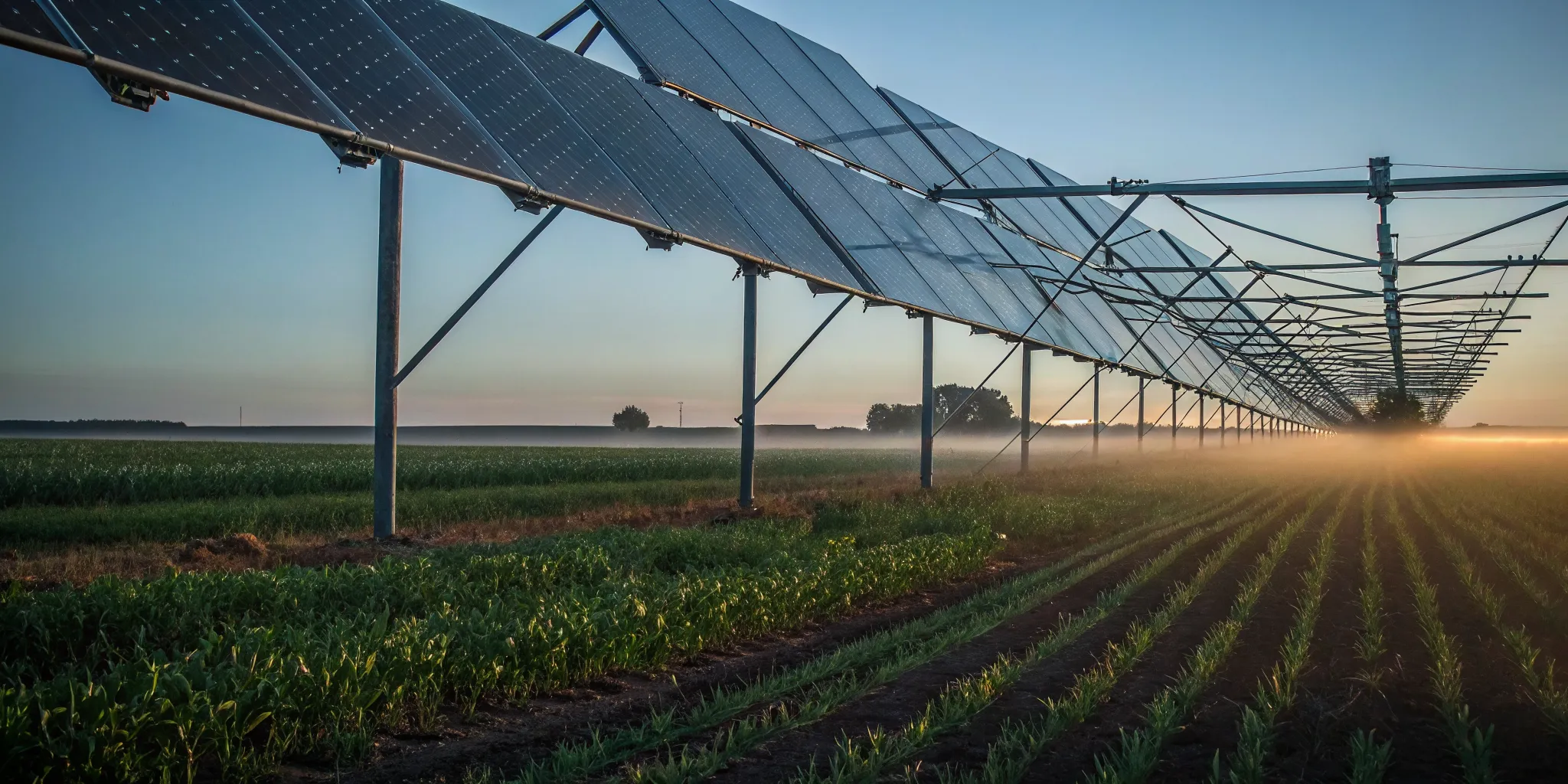
Center-pivot irrigation systems water a circular area, leaving the four corners of a square quarter-section (roughly 28 acres per corner on a 160-acre field) without irrigation. Research from Kansas State University and the University of Kansas shows these corners can support ground-mounted solar arrays that generate up to 14% of the field's annual pumping energy.
- Unused corner area: Approximately 18% of a quarter-section field
- Energy offset potential: Up to 14% of irrigation energy from corner arrays
- Secondary benefit: Panel shade reduces soil moisture evaporation in corner areas
High Plains Aquifer Management
Water levels in the High Plains Aquifer continue to decline across western and central Kansas. Solar technology helps address this challenge by providing low-cost power for efficient irrigation technologies like variable-frequency drives and soil moisture sensors. These tools reduce total water pumped per acre without reducing yield.
Building a Resilient Farm Grid
A well-designed solar array with battery storage provides grid independence during peak summer demand events when Evergy may implement demand response curtailments. Even without storage, solar generation during daylight hours, when irrigation pumps run hardest, directly offsets the farm's peak grid draw. Barkley Solar's full efficiency approach evaluates the complete energy profile before recommending system sizing.
Solar for Grain Drying: Offsetting Peak Power Demand
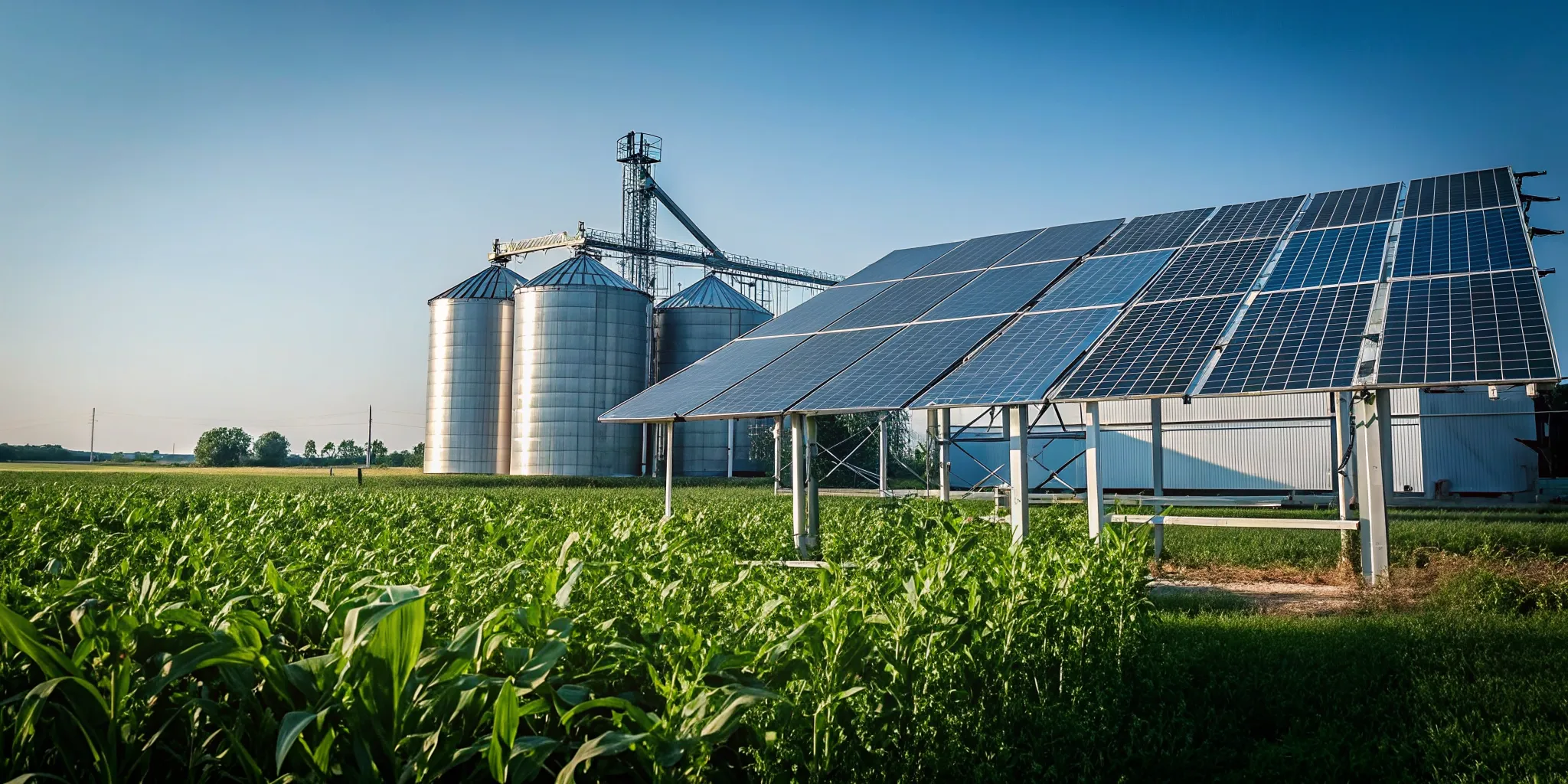
Grain drying is a concentrated, high-intensity energy load that typically runs six to ten weeks per year. Large grain elevators in Kansas often see annual electric bills exceeding $50,000, with the majority incurred during the September-November drying season. Solar arrays sized for this load profile change the cost structure of fall harvest.
Lowering High Harvest Season Bills
Evergy's commercial rate structure includes demand charges that are calculated based on the farm's highest 15-minute power draw during the billing period. Grain drying equipment, large fans and propane or electric heaters, creates extreme demand spikes that inflate the farm's rate base for the entire year. Solar generation during the drying season reduces net demand and lowers the demand charge calculation for subsequent months.
Solar and Backup Power Integration
Grain drying cannot tolerate power interruptions. A failed drying cycle can lead to spoilage that destroys a season's revenue. Solar arrays paired with battery storage or generator backup provide the reliability grain operations require. The solar array handles the daytime baseload; the backup source covers overnight or grid-outage periods.
Seasonal Load Management to Maximize Credits
Kansas net metering's indefinite credit rollover is the feature that makes grain-drying solar economics work. A farm that generates 20,000 kWh of surplus energy during July and August accumulates credits worth approximately $2,000 at current rates. Those credits are drawn down during September and October when the dryers run. Keeping the system at peak performance through commercial solar maintenance ensures maximum credit generation during high-production months.
Dual-Use Solar: Making the Most of Kansas Farmland
Agrivoltaics, the practice of co-locating crop or livestock production with solar generation, is gaining traction in Kansas as landowners seek to maximize per-acre revenue. Research from Colorado State University and the University of Arizona shows that strategic panel placement can increase total land productivity by 35-73% compared to single-use farming.
What Is Agrivoltaics?
Agrivoltaic systems raise solar panels eight to twelve feet above grade on elevated mounting structures. This clearance allows standard farm equipment, tractors, sprayers, balers, to operate beneath the array. Crops that tolerate partial shade, such as wheat, alfalfa, and certain native grasses, perform well under these conditions.
How Shade Protects Crops and Livestock
Research from Colorado State University demonstrates that panel shade reduces plant heat stress during Kansas's peak summer temperatures. Shaded crops require less irrigation water to maintain yield. For livestock, solar arrays provide shaded resting areas that improve weight gain and reduce heat-related mortality in cattle and sheep.
Field Corner Applications
Agrivoltaic principles apply directly to the center-pivot field corners described above. These unirrigated areas, roughly 18% of each quarter-section, are the highest-value locations for ground-mounted arrays. Research at the Kansas Geological Survey is exploring integrated water catchment beneath field-corner arrays that could recharge local groundwater while generating power.
Solar battery storage options can complement a field-corner array by storing surplus daytime generation for evening irrigation or overnight grain drying.
How to Start Your Agricultural Solar Project in Kansas
Launching a farm solar project requires a structured approach. Barkley Solar's commercial team, led by VP of Commercial Sales Dan Rea with 21+ years of solar experience, handles the process from initial energy audit to utility interconnection.
- Complete an energy audit. Review 12-24 months of utility bills to establish baseline consumption, identify peak demand periods, and calculate the optimal system size. Include all loads: irrigation pumps, grain dryers, livestock ventilation, shop equipment, and farmhouse.
- Schedule a site survey. Barkley Solar evaluates roof condition, ground space, shading, and soil composition for ground-mounted arrays. Commercial solar installation partners assess structural requirements and electrical panel capacity.
- Run an incentive analysis. Calculate the exact ITC, MACRS, and Kansas property tax exemption amounts for the proposed system size. Include any USDA REAP grant eligibility if applicable.
- Design the system. Use Helioscope or similar software to optimize panel layout, inverter selection, and string sizing. Account for field-corner arrays, roof space, and dual-use agrivoltaic potential.
- Submit permits and interconnection application. Barkley Solar handles building permits, electrical permits, and Evergy interconnection paperwork. The utility typically responds within 30 days.
- Install and commission. Professional installation takes 2-4 weeks depending on system size and site conditions. The utility installs a bi-directional meter and issues a permission to operate letter.

Switch to Agricultural Solar and Lower Your Kansas Farm Operating Costs
Kansas agricultural producers face a structural choice. Continue paying escalating Evergy rates for irrigation, grain drying, and livestock power, or invest in a solar asset that delivers 25+ years of near-zero energy costs after a 5-8 year payback.
The financial case rests on three pillars that apply specifically to Kansas farm operations:
- Federal: 30% Investment Tax Credit applied against farm income tax liability
- State: Kansas property tax exemption prevents solar from increasing land assessments
- Utility: Evergy 1:1 net metering provides full retail credit for exported power
Agricultural solar in Kansas turns a fixed operating cost into a capital investment with predictable returns. The same sun that grows Kansas wheat, corn, soybeans, and milo can also power the equipment that plants, irrigates, dries, and harvests it.